
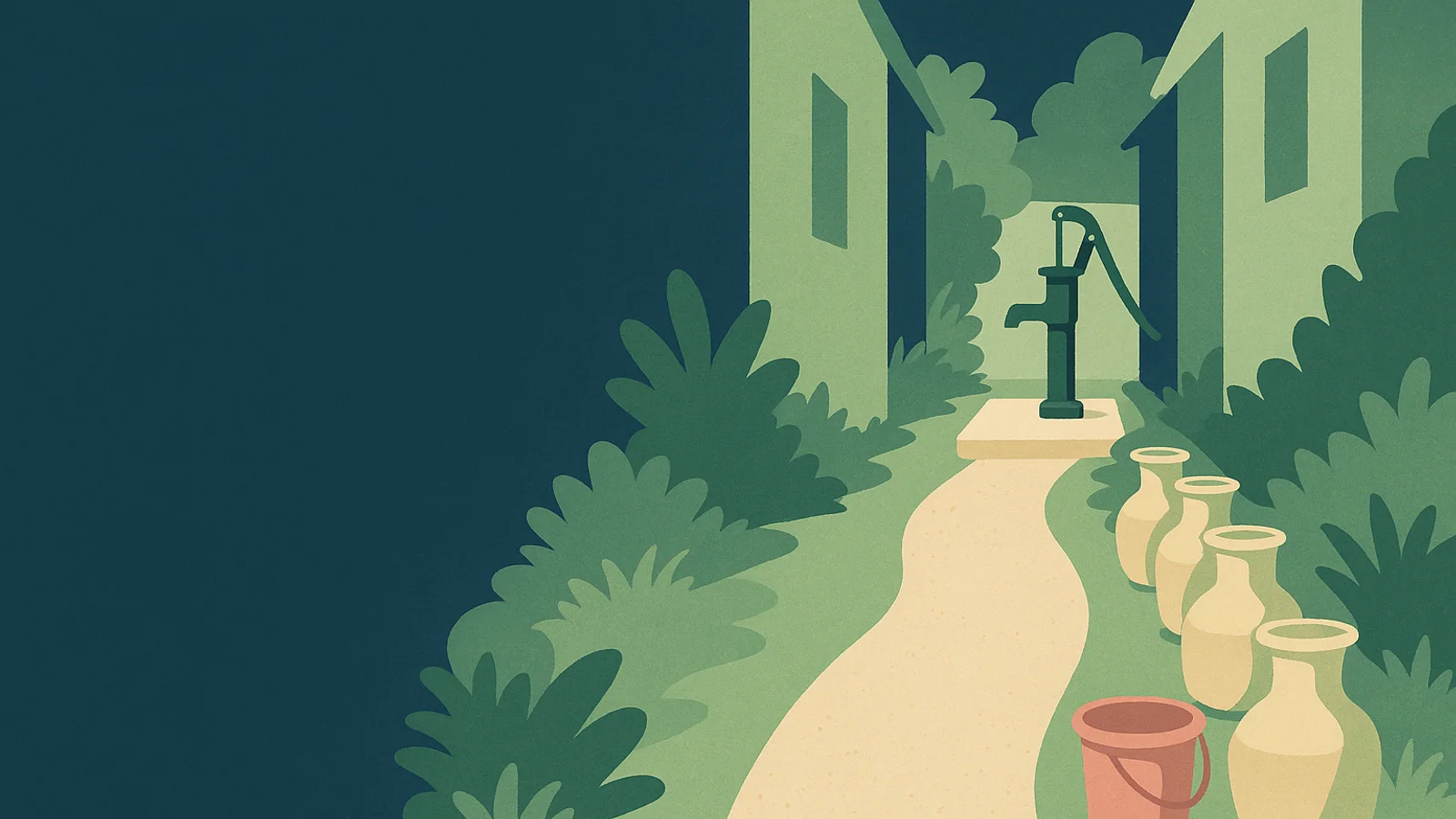
In [the student's chosen lane, para or short street], how much time do households spend each day fetching water from shared tube wells or taps, and who in the household usually does this work?
Complexity
Who Walks for Water? Time, Distance and Gender at Shared Water Points in One Neighbourhood
Alternative title — “The Water-Fetching Clock: Measuring Time, Distance and the Gender Gap at Shared Tube Wells and Taps”
Students measure how long households spend fetching water from a shared tube well or tap in one lane, and who in the household does this work. Through a 50-100 household survey, 10-15 interviews, and geo-tagged photos, they test whether distance increases fetching time and whether women and girls bear more of this burden. The project yields a local, countable picture of a widely assumed but rarely measured pattern.
Summary
This project measures how much time households spend fetching water from a shared water point (a tube well or stand tap used by more than one household) in one lane, para or short street, and who in the household does this work. Students will run a short survey of 60-80 households in their chosen area, interview people who know the water point well (women who fetch, an elder, a mechanic, a local official), and take geo-tagged photos of the water point, the queue, and the paths households walk. They will compare fetching time and effort by distance from the source and by who does the fetching (woman, man, girl, boy, elder). At the end, the student will be able to describe, for their specific lane, how long water-fetching takes on a typical day, whether farther households pay more time, and whether this work falls mostly on women and girls there - a finding that matters directly to the families who live it.
Why this matters
In many Bangladeshi neighbourhoods, water does not arrive by itself. Someone walks to a tube well or tap, waits in line, fills containers, and carries them home - sometimes several times a day. This work takes time that could go to school, paid work, or rest. In many households it is done mostly by women and girls, which is part of why water access is not only a health issue but also a fairness issue.
Walk through your own para or lane and you will likely see the pattern already: a small cluster of containers waiting their turn at one tube well, a girl carrying a kolshi (pitcher) past the market on her way to school, a queue that is short at 6 a.m. and long at 6 p.m. Nobody has measured, for that specific lane, how many minutes this actually costs each household, or whether households that live farther from the source pay more of that cost. This project turns something everyone has seen into something that can be counted, compared and reported - for one real place.
Background
- Large shares of households in parts of Bangladesh rely on shared, not private, water sources, especially in informal and peri-urban areas - household survey and WASH sector reports [verify].
- Time spent collecting water is recognised internationally as a measurable burden that falls disproportionately on women and girls - WHO/UNICEF Joint Monitoring Programme reports [verify].
- Distance to a water source is commonly used as a proxy for burden in WASH research, with longer distances linked to less time for school and income work - WASH sector and development agency studies [verify].
- In Bangladesh, shared tube wells and public stand taps are common in slums, bustees and rural lanes, often serving groups of households rather than single homes - DPHE (Department of Public Health Engineering) and local NGO field reports [verify].
- Breakdowns of shared sources (broken hand pumps, leaking taps) can increase queueing time and push households toward farther or lower-quality backup sources - local NGO WASH monitoring reports [verify].
- Arsenic-marking paint on tube wells (commonly red for unsafe, green for safe) is a known feature of many Bangladeshi tube wells, though marking condition varies - DPHE arsenic mitigation documentation [verify].
- Division of household labour, including water fetching, is often described qualitatively in gender and development literature as "women's work," but local, countable evidence from specific lanes is rare - gender and WASH academic literature [verify].
- No published study appears to measure, for a single named Bangladeshi lane or para, the exact minutes per day spent fetching water compared with distance and with who does the work - this is the gap this project fills locally.
Research question and hypothesis
Primary question: In [the student's chosen lane, para or short street], how much time do households spend each day fetching water from shared tube wells or taps, and who in the household usually does this work?
Secondary questions:
- Does total daily fetching time increase with distance from the household to the shared water point?
- How does the person who usually fetches water (by gender and age group) compare with household members' own view of whose job it is, and does this affect school or work time?
Hypothesis: Households living farther from a shared water point spend more total minutes per day fetching water, and in most households, women and girls carry more of this time burden than men and boys.
What a null result looks like: fetching time does not clearly rise with distance in this sample (for example, because queue length matters more than walking distance), or the work is shared fairly evenly across genders and ages in this particular lane. Either outcome is a real and useful finding - it would mean the local pattern differs from what is often assumed, and the paper should say so plainly.
Who should do this
Suggested team size: 2 to 4 students work best (up to 5 can join), because the project needs door-to-door household visits, interviews on different schedules, and careful photo/map work at the same site, often at different times of day.
By region:
| Region | What changes locally |
|---|---|
| Dhaka | Choose a lane in a bustee or low-income para with shared standpipes or tube wells; WASA supply timing may also affect queueing. |
| Chittagong | Hillside or port-edge settlements often share tube wells across clustered homes; distances may be steeper, not just longer - note this in the field diary. |
| Noakhali | Tube wells may be spaced farther apart due to salinity in shallow water; some households may also collect from ponds as backup - record this as a second source. |
| Sylhet | Tea-garden labour lines or haor-edge paras often share a small number of tube wells among many households; note any tea-garden management role in water point upkeep. |
Role split for a team of 4:
- Survey lead builds and manages the AKTI Survey, tracks which households have responded, and checks data quality.
- Interview lead schedules and records the video interviews, keeps the consent forms.
- Photo and map lead takes all geo-tagged photos, keeps the photo log, and draws a simple sketch map of the lane showing households and the water point(s) with approximate distances.
- Data lead keeps the field diary, cleans survey data, and builds the charts described in Section 14.
Evidence plan
| Evidence type | What it will show for this question | How much is enough | Why it fits |
|---|---|---|---|
| AKTI survey | Self-reported distance, trips per day, minutes per trip, who fetches, by household | 60-80 households | Gives a countable, comparable picture across many households in the same lane |
| Video interviews | Lived experience, history of change, maintenance problems, and views on who does the work and why | 6-8 interviews, 3-8 minutes each | Adds detail and explanation the survey numbers cannot give alone |
| Geo-tagged photos | The water point's physical condition, the queue, paths, containers, and relative distances | 15-25 photos across at least 3 visits at different times of day | Shows what the site actually looks like and supports the sketch map and queue-timing notes |
| Field diary | Dates, times of day, weather, who was present, any unusual events (e.g., source broken that day) | Entry for every single field visit | Lets the student explain context later - including any season or time-of-day effect |
Survey design
Target: households that use at least one shared tube well or shared tap (not a private in-house connection) as a main or backup water source.
- How many people live in your household? — Number
- What is your household's main source of drinking and household water? — Single choice: Shared tube well / Shared tap or standpipe / Private tube well inside the home / Pond or river / Water vendor or jar water / Other
- Is this main source shared with other households? — Single choice: Yes / No / Not sure
- About how far is this water source from your home? — Single choice: Less than 50 metres / 50-100 metres / 100-200 metres / 200-400 metres / More than 400 metres / Not sure
- On a typical day, about how many minutes does ONE round trip to fetch water take, including walking and waiting in line? — Number (minutes)
- On a typical day, how many round trips does your household make to fetch water? — Number
- Who most often fetches water for your household? — Single choice: Mother / adult woman / Father / adult man / Daughter under 18 / Son under 18 / Grandmother or elder woman / Grandfather or elder man / Hired help / Other
- Besides the person named above, who else sometimes helps fetch water? — Multiple choice: Mother / adult woman / Father / adult man / Daughter under 18 / Son under 18 / Grandmother or elder woman / Grandfather or elder man / Hired help / No one else / Other
- What is the age group of the person who most often fetches water? — Single choice: Under 12 / 12-17 / 18-40 / 41-60 / Over 60
- Does fetching water ever make that person late for or miss school or work? — Single choice: Yes, often / Yes, sometimes / Rarely / Never / Not applicable
- How many containers does your household usually fill per trip? — Number
- What type of container do you mainly use to carry water? — Single choice: Bucket / Kolshi (pitcher) / Jerry can / Drum / Other
- In the last month, has anyone in your household felt pain, tiredness or injury from carrying water? — Single choice: Yes / No / Not sure
- At the busiest time of day, about how long do you usually wait in line at the water point? — Single choice: No wait / Under 5 minutes / 5-15 minutes / 15-30 minutes / More than 30 minutes
- Does your household ever use a second (backup) water source when the main one is busy, broken, or dry? — Single choice: Yes / No
- If yes, what is this backup source? (Leave blank if you answered No above) — Short text
- In the past month, how many times was your main water source broken or not working? — Number
- Who usually repairs or maintains your shared water source? — Single choice: A mechanic paid by the community / Union parishad (local government) / An NGO / No one / not sure / Other
- How satisfied are you with the amount of time it takes to get water each day? — Scale 1-5 (1 = Very dissatisfied, 5 = Very satisfied)
- Do you think the time spent fetching water affects women's or girls' time for school, work or rest in your household? — Single choice: Yes, a lot / Yes, a little / No / Not applicable
Target respondent: one adult (18+) per household who knows the household's water routine well - usually the person who manages water or a parent/guardian.
Response target: 60-80 households.
Recruitment: go door to door along the chosen lane, both sides of the street, introducing yourselves as Rainflower student researchers. Use the consent script (Section 10) before starting. If a household declines, thank them and move to the next house; record the refusal in the field diary (no details needed, just a tally).
Pilot plan (3-5 households): Before the full round, test the survey on 3-5 households. Watch for: (a) whether "shared" is understood the same way by everyone (clarify with an example: "used by more than just your family"); (b) whether people can estimate minutes and distance without confusion - if not, show simple landmarks for distance bands; (c) whether Question 16 is skipped properly when the answer to Question 15 is "No." Fix wording with your coach before continuing, and note any changes in your field diary.
Sampling and limits
Who and how: choose one lane, para or short street segment with 2 to 4 shared water points serving roughly 30 to 80 households. Visit every household along both sides of the street in order (door to door), not just the easiest-to-reach ones. If the area is larger than your target sample, survey every second or third household in a fixed pattern (for example, every second house) rather than picking only friendly-looking homes.
What this sample can claim: a description of water-fetching time, distance and gender patterns for this specific lane, on the dates the data was collected. It cannot be used to describe the whole city, the whole region, or Bangladesh generally.
What it cannot claim: that findings apply beyond the study lane, or that the pattern is the same in every season - note the data collection dates and discuss possible seasonal effects (for example, dry-season wells running low, or monsoon mud slowing the walk) in the Discussion.
Obvious bias and how to reduce it: households that are home during daylight hours when students visit may differ from households where everyone works outside (for example, more likely to include stay-at-home caregivers). Reduce this by visiting at two different times of day (e.g., one morning round and one late-afternoon round) across the data collection weeks, and recording the visit time for each household in the field diary.
Interview guide
Roles to interview (choose 6-8):
- A mother or other adult woman who regularly fetches water
- An elder (man or woman) who remembers water fetching in this area years ago
- A tube-well mechanic or pump repairer
- A union parishad member or local official involved with water points
- An NGO or DPHE field staff member working on WASH in the area (if available)
- A school teacher or caretaker who may notice students arriving late
- A community clinic worker (for health effects of carrying water)
- An adult man or father, for his view on who does this work and why
Interview questions (use 8-12 relevant to the role):
- Can you describe a typical day of fetching water for your household - how many trips, what time, and who goes?
- How has the time it takes to fetch water here changed over the last 5-10 years, in your memory?
- What problems do you see at the shared water point (long queues, breakdowns, arguments)?
- In most households you know here, who usually does the water-fetching work, and why do you think that is?
- Have you noticed children being late for school, or missing school, because of fetching water?
- When the source breaks down, how long does it usually take to get fixed, and who fixes it?
- Have you seen any conflicts or arguments at the water point? What were they usually about?
- What would make fetching water faster or easier for people here?
- (Mechanic) What usually breaks on this type of source, and how often do you repair it?
- (Clinic worker) Have you seen health problems you think are linked to carrying water - back pain, falls, injuries?
- (Official/NGO staff) Are there any plans to add more water points or fix broken ones in this area?
- Have you noticed any change in who fetches water now compared to before - for example, more men helping than in the past?
Consent script - English
"Hello, my name is [name] and I am a student researcher with Rainflower, a youth water research programme. We are studying how water is fetched from shared water points in [name of lane/area]. I would like to ask you some questions.
First, can I ask: are you willing to take part in this interview? [wait for answer] Second, may I record this conversation on my phone? [wait for answer] Third, may I use what you say, without your name, in a research paper that may be shared publicly? [wait for answer]
You can stop at any time, and you do not have to answer any question you are not comfortable with. I will not use your full name, phone number or home address in the paper."
সম্মতি বার্তা - বাংলা
"আসসালামু আলাইকুম/নমস্কার, আমার নাম [নাম] এবং আমি রেইনফ্লাওয়ার যুব গবেষণা কর্মসূচির একজন শিক্ষার্থী গবেষক। আমরা [এলাকার নাম]-এ ভাগাভাগি পানির উৎস থেকে পানি সংগ্রহ নিয়ে গবেষণা করছি। আমি আপনাকে কিছু প্রশ্ন জিজ্ঞাসা করতে চাই।
প্রথমত, জিজ্ঞাসা করতে পারি: আপনি কি এই সাক্ষাৎকারে অংশ নিতে ইচ্ছুক? [উত্তরের অপেক্ষা করুন] দ্বিতীয়ত, আমি কি আমার ফোনে এই কথোপকথন রেকর্ড করতে পারি? [উত্তরের অপেক্ষা করুন] তৃতীয়ত, আপনার নাম ছাড়া, আমি কি আপনার কথা একটি গবেষণাপত্রে ব্যবহার করতে পারি, যা সর্বজনীনভাবে প্রকাশিত হতে পারে? [উত্তরের অপেক্ষা করুন]
আপনি যেকোনো সময় থামতে পারেন, এবং যেকোনো প্রশ্নের উত্তর না দেওয়ার অধিকার আপনার আছে। আমি আপনার পূর্ণ নাম, ফোন নম্বর বা বাড়ির ঠিকানা গবেষণাপত্রে ব্যবহার করব না।"
Recording tips: record in a quiet public place, phone held horizontally (landscape mode), 3-8 minutes long. At the start, say the date and the person's role out loud (for example, "October 2026, interview with a mother who fetches water"). If the person prefers not to show their face, record their hands, the water point, or point the camera slightly away from their face while keeping their voice clear.
Photo and observation plan
Turn on location tagging: in your phone's camera settings, turn on "Location" or "GPS tagging" so every photo saves the place it was taken. Check this works before your first field visit by taking a test photo and checking it shows a location in your photo gallery app.
- Wide shot of the shared water point (tube well or tap) from a public spot - shows its design and general condition.
- A queue of people waiting at the water point, taken from the side or behind - shows how busy it gets (avoid close-ups of faces).
- Containers lined up waiting their turn - shows how people reserve their place in line.
- The path from a sample household toward the water point - shows distance and ground conditions (mud, steps, obstacles).
- Any arsenic-marking paint on the tube well (commonly red or green) - shows marking condition.
- Any visible damage - broken handle, leaking pipe, cracked platform - shows maintenance state.
- Standing water, mud, or other hazards around the water point - shows safety and hygiene conditions at the site.
- Different container types used by households (bucket, kolshi, jerry can, drum) - shows carrying method and rough volume.
- Any handwashing spot or drainage channel near the source, if present - shows sanitation features.
- Any posted rule, sign or notice about the water point's use or timing, if one exists.
- A wide shot of the lane showing the relative position of several homes to the water point - useful for your sketch map.
- A mechanic or community member doing repair work, only with their clear permission.
Photo log: for every photo, write in your notebook: photo number, date, time, place type (e.g., "shared tube well, lane entrance"), and one sentence on what it shows.
Faces, children and homes: do not photograph anyone's face without their separate permission (the third consent question). Do not photograph children up close or inside anyone's home. Take photos only in public spaces such as the street, the water point, and its surroundings - never enter a private yard or home without the owner's clear invitation.
Optional measurements
These are OPTIONAL. The study works fully from survey, interview and photo evidence alone; use these only if time and comfort allow.
- OPTIONAL - Queue timing: use your phone's stopwatch to time how long 5-10 different people wait in line at three times of day (morning, midday, evening) on a non-random day. This adds an observed measure alongside self-reported wait times (Question 14).
- OPTIONAL - Distance check: use your phone's map app or simply count your own walking paces (and convert to metres) from 3-5 sample households to the water point, to check against the self-reported distance bands (Question 4).
- OPTIONAL - Container count: during one fixed 30-minute observation window, count how many containers are filled, to get a rough sense of total water point traffic.
- OPTIONAL - Container size: measure a sample container's height and width with a tape measure (in centimetres) to estimate its volume in litres, to add context to "number of containers" answers.
These measurements describe timing, distance and traffic. They say nothing about water quality or safety - this study does not test or claim anything about whether the water is safe to drink.
Timeline
| Stage | Weeks | What the student does for this topic | What is submitted |
|---|---|---|---|
| 1. Choose and plan | 1-2 | Choose the exact lane/para, confirm it has 2-4 shared water points and 30-80 households; draft the research question and survey | Draft plan and chosen study area description |
| 2. Permission, checklist, pilot | 2-3 | Get family and any needed local permissions; pilot survey on 3-5 households; refine wording | Coordinator checklist; piloted survey |
| 3. First sample and advisor review | 3-4 | Survey first 15-20 households; conduct 1-2 pilot interviews; take first photos | First-sample summary for advisor review |
| 4. Full data collection | 5-8 | Complete survey to target (60-80); complete 6-8 interviews; complete photo set at 3+ visits/times | Full survey dataset, interview recordings, photo log |
| 5. Analyse | 9-10 | Clean data; build tables and charts comparing distance, time and gender | Draft tables/charts |
| 6. Write | 11-12 | Write the paper following the outline in Section 17 | Full draft paper |
| 7. Final review and submit | 13 | Coordinator checklist review; revise; submit to Rainflower | Final paper and evidence package |
Analysis plan
What to count:
- Average minutes per round trip and average trips per day, per household, to get total minutes per day per household (Q5 x Q6).
- Average total daily fetching minutes grouped by distance band (Q4).
- Share of households where the main fetcher (Q7) is: woman/girl vs man/boy vs elder.
- Share of households reporting missed/late school or work because of fetching (Q10).
- Share reporting pain/injury (Q13), broken source in the past month (Q17), and satisfaction score (Q19).
Comparisons to make:
- Total daily fetching minutes by distance band (near vs far).
- Gender of main fetcher compared with whether that person's school/work is affected (Q7 x Q10).
- Satisfaction score (Q19) compared with wait time band (Q14).
- Self-reported distance (Q4) compared with any observed/paced distance, if the optional measurement was done.
Charts to draw:
- Bar chart: average total daily fetching minutes by distance band.
- Pie or bar chart: share of households by who usually fetches water (gender/age categories from Q7).
- Bar chart: share of households reporting school/work effects (Q10), split by gender of main fetcher.
- Scatter or grouped bar: satisfaction score (Q19) against wait time band (Q14).
Worked example (example, not a result):
Suppose, from 70 surveyed households, the following average daily minutes by distance band were found:
| Distance band | Example average minutes/day (invented) |
|---|---|
| Under 50m | 18 |
| 50-100m | 25 |
| 100-200m | 34 |
| 200-400m | 47 |
| Over 400m | 61 |
If the real data shows a similar rising pattern, the student could write: "In this lane, households farther from the shared tube well spent more time fetching water each day, consistent with our hypothesis." If the real data instead shows no clear rise, the student should report that plainly as a null result and consider other explanations (for example, queue length mattering more than distance).
Ethics and safety
Three permissions, asked separately, every time: (1) willingness to take part, (2) willingness to be recorded, (3) willingness to have responses used publicly (without name). Use the script in Section 10 for interviews, and a short written or read-aloud version for survey respondents before starting the AKTI survey.
Under 18: if any survey respondent or interviewee is under 18 (for example, a daughter who fetches water and whose view matters), get a parent or guardian's spoken or written agreement first, in addition to the young person's own agreement.
Privacy: never record full names, phone numbers, or home addresses in the survey or paper. Describe people by role only ("a mother who fetches water," "a tube-well mechanic"). Raw data (survey export, video files, photo files with location tags) stays in the private evidence package and is not published; only summarised, anonymised findings go in the paper.
Physical safety for this study: work only in daylight, in public areas (the street, the water point itself if it is a public space). Do not enter anyone's yard or home without a clear invitation. Stay clear of open wells, slippery platforms, or fast-flowing drainage near the water point. Tell a family member where you are going and when you will return before every field visit. Never climb onto water infrastructure (platforms, tanks, pipes) to get a photo.
Data retention: keep raw survey exports, interview recordings and photo files until the project is graded and accepted by Rainflower, then archive or delete as instructed by your coordinator.
Expected outcomes and limitations
Questions the data could answer:
- Does total daily fetching time rise clearly with distance in this lane, or not?
- Is water-fetching mostly done by women and girls here, or is it shared more evenly than expected?
- Does fetching water appear linked to missed school or work time for the people who do it?
- How often does the shared source break down, and does this push households toward backup sources?
A null or surprising result (for example, no clear link between distance and time, or fetching shared evenly across genders) is a genuine and useful finding - it means this lane does not follow the common assumption, and that is worth reporting honestly.
Limitations (stated in advance):
- Self-reported minutes and distances are estimates, not measured times, unless the optional timing/pacing steps are done.
- The sample is one lane/para and cannot represent the whole city or region.
- Data collected in one season may not reflect fetching time in another season (for example, dry-season well levels or monsoon mud); this must be discussed, not ignored.
- Households reached during daylight visiting hours may differ from households that are empty most of the day.
- People may adjust their answers if they think the student represents an authority who could "fix" the water point, which could bias satisfaction or complaint-related answers.
Paper outline
- Abstract (150-200 words): the question, method, sample size, and headline finding for this specific lane.
- Introduction: why water-fetching time and gender matter, framed around the chosen lane, ending with the research question.
- Methods: study area description (without exact address), survey design, sample size and recruitment, interview roles, photo plan, dates of data collection.
- Results: survey findings with tables/charts from Section 14 (distance vs time, gender of fetcher, school/work effects), interview quotes by role, selected photo descriptions.
- Discussion: what the pattern means for this lane, how it compares with what interviewees said, how season or time of day may have affected results.
- Limitations: the points from Section 16, stated honestly.
- Conclusion: a short, honest answer to the research question for this lane, and one practical suggestion if the data supports it (for example, for the union parishad or NGO).
- AI-use statement: exactly what AI was used for (for example, grammar checking, table formatting) and confirmation that no results, quotes or conclusions were AI-written.
- Ethics statement: confirmation of the three-permission process, parental consent for minors, and privacy steps taken.
- References: types of sources used, each marked [verify] where not personally checked by the student.
Figures/tables to include: the distance-vs-time bar chart, the who-fetches-water chart, the school/work-effect chart, and the simple sketch map of the lane with the water point(s) marked.
Word range: 5,000-10,000 words for the main paper body (excluding references and statements).
Budget
| Item | Reason | Cost (BDT) |
|---|---|---|
| Local travel (rickshaw/bus/CNG for field visits) | Getting to and from the study lane across 13 weeks | 3,000 |
| Mobile data | Uploading survey responses, video interviews, and photos | 1,000 |
| Printing | Backup paper survey sheets and consent forms | 500 |
| Notebook and pens | Field diary and photo log | 200 |
| Tea/snacks for interviewees (courtesy, not payment) | Polite gesture of thanks, not compensation for answers | 800 |
| Contingency | Unplanned small costs | 1,000 |
| Total | 6,500 |
Estimated hours per student (whole project): about 42 hours per student.
Rough breakdown per student: Plan (4 hrs) + Permission/pilot (4 hrs) + First sample (5 hrs) + Full data collection (18 hrs) + Analyse (5 hrs) + Write (5 hrs) + Final review (1 hr) = 42 hrs.
Before-you-start checklist
- Chosen one specific lane, para or short street with 2-4 shared water points and roughly 30-80 households
- Confirmed the water point(s) are genuinely shared (used by more than one household)
- Told a family member about the study plan and field visit days
- AKTI Survey account set up and the 20 questions entered and tested
- Consent scripts printed or saved, in both English and Bangla
- Pilot survey run with 3-5 households and wording adjusted if needed
- List of 6-8 interview roles identified, with at least one contact per role
- Phone camera location tagging checked and working
- Field diary notebook ready, with a page per planned visit date
- Coordinator checklist review completed before starting full data collection
- Team roles assigned (survey, interview, photo/map, data) if working in a team
Glossary
- Tube well (নলকূপ): a hand-pump well that draws groundwater, often shared by several households.
- Shared water point: a tube well or tap used by more than one household, not a private connection.
- Stand tap/standpipe: a public water tap, often connected to a piped supply system.
- Kolshi: a traditional pitcher used to carry water.
- WASA: Water Supply and Sewerage Authority, the agency supplying piped water in some Bangladeshi cities.
- DPHE: Department of Public Health Engineering, a government agency involved in rural and tube-well water supply.
- Union parishad: the local government council at the union (small administrative area) level.
- Arsenic marking: paint (commonly red or green) used to show whether a tube well's water has tested safe or unsafe for arsenic.
- Geo-tagged photo: a photo saved with its location (coordinates) attached, using phone GPS.
- Field diary: a dated, ongoing notebook record of what was done, seen and said during fieldwork.
- AKTI Survey: the free online survey tool used by Rainflower students to build and run their surveys.
- Consent: a person's clear agreement, given separately for taking part, being recorded, and having answers shared publicly.
- NGO: non-governmental organisation, often involved in water and sanitation projects locally.
- WASH: Water, Sanitation and Hygiene, a common term for this field of work.
- Null result: a finding that does not show the expected pattern - still a valid and reportable scientific result.
Share this proposal with your Rainflower coordinator before starting any fieldwork. Bring back any questions or requested changes, and you can adjust the survey, sample size, or timeline together.
Skills you'll use
Want to write this?
Take it on as a Rainflower researcher, get matched with a coordinator, and earn 💧 1000 when Rainflower accepts your paper.
Questions
Sign in to read and ask questions about this paper.